FREE SYMPOSIUM OF AMB. JUAN

Sunday, December 9, 2018
Friday, November 23, 2018
Protecting the planet rests on this generation’s youth and their inclination “to hold leaders and decision-makers accountable,” especially in the combat against climate change, United Nations Deputy Secretary-General Amina Mohammed told university students in China
Deputy UN Secretary-General Amina Mohammed lectures on climate change at Tsinghua University in Beijing, China. (21 November 2018)
She highlighted that the last three years have been the warmest on record, spotlighting signs of climate change such as more frequent and exceedingly intense natural disasters, and declines in food security and prosperity.
The latest report from the UN Intergovernmental Panel on Climate Change (IPCC) makes clear that the pressure is on to limit the rise in global temperature to 1.5 degrees Celsius.
Neglecting to address these warnings signs means leaving the future vulnerable to competition over scarce resources, injuring economies, and creating “a fertile ground” for chaos.
She turned to the younger generation for hope to protect the planet.
“I am counting on young people like yourselves to hold leaders and decision-makers accountable to ensure a secure future for yourselves and future generations,” she told students.
Praising collective action, she said the Paris Agreement, a pact within the UN framework convention, known by the acronym UNFCCC, aimed to strengthen the global response to climate change, indicated a strong start for countries committing to lowering their emissions, and added that the Agreement’s potential has yet to be fully unleashed.
Countries must raise their ambitions, she counseled, and implement their own national contributions, highlighting that China has done its part in deploying more solar and wind capacity than any other country in the world in the last five years.
“We have all the tools we need to create a new reality and you are in a position to lead us with new innovations,” she said.
“Let us join hands and use this as an opportunity to strive for a healthy, prosperous and sustainable future for all.”
The latest report from the UN Intergovernmental Panel on Climate Change (IPCC) makes clear that the pressure is on to limit the rise in global temperature to 1.5 degrees Celsius.
Neglecting to address these warnings signs means leaving the future vulnerable to competition over scarce resources, injuring economies, and creating “a fertile ground” for chaos.
She turned to the younger generation for hope to protect the planet.
“I am counting on young people like yourselves to hold leaders and decision-makers accountable to ensure a secure future for yourselves and future generations,” she told students.
Praising collective action, she said the Paris Agreement, a pact within the UN framework convention, known by the acronym UNFCCC, aimed to strengthen the global response to climate change, indicated a strong start for countries committing to lowering their emissions, and added that the Agreement’s potential has yet to be fully unleashed.
Countries must raise their ambitions, she counseled, and implement their own national contributions, highlighting that China has done its part in deploying more solar and wind capacity than any other country in the world in the last five years.
“We have all the tools we need to create a new reality and you are in a position to lead us with new innovations,” she said.
“Let us join hands and use this as an opportunity to strive for a healthy, prosperous and sustainable future for all.”


Saturday, November 17, 2018
Sunday, November 4, 2018
SDG: More countries partner to target #ZeroHunger in global south - UN Sustainable Development Goals
FAO/Alessandro Stelzer
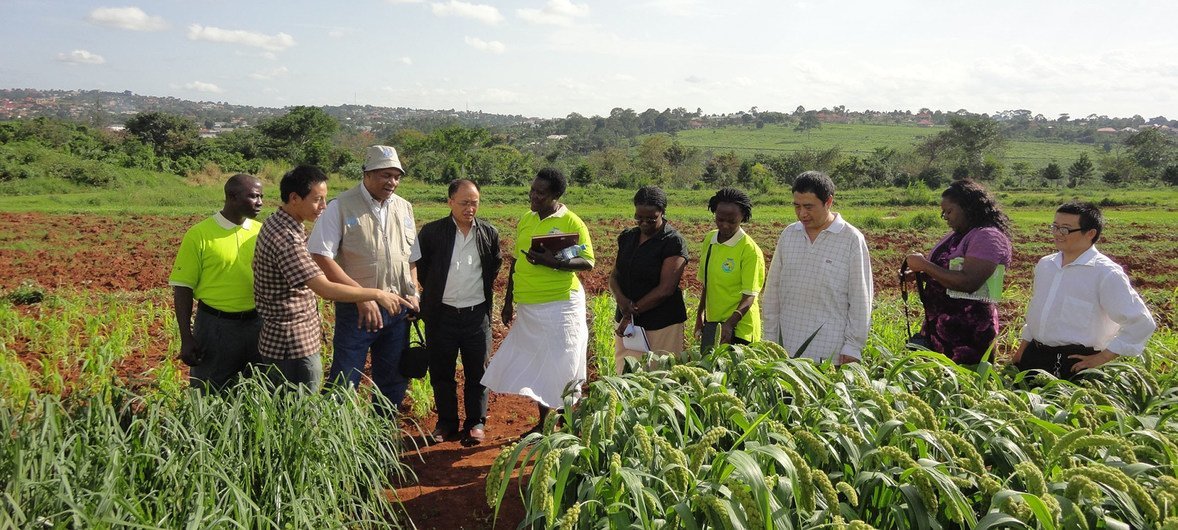
FAO’s South-South Cooperation promotes collaboration and knowledge sharing between Chinese experts and Ugandan farmers.
2 November 2018
Humanitarian Aid
More than 20 countries committed to a new declaration on agricultural and rural development on Friday, in a bid to stamp out poverty and hunger. The commitment came at the end of a forum on international development cooperation in Changsha, China.
The Changsha Declaration aims to ramp up the efforts towards South-South Cooperation - an initiative working to eliminate hunger and malnutrition through the mutual sharing and exchange of good practices, resources, and know-how between countries of the “global south”.
At the forum’s conclusion, 26 countries and 11 international organizations signed on to the Declaration, which includes more information-sharing towards constructing common policies and programmes.
The forum coincided with the launch of a new report, jointly published by the Food and Agriculture Organization (FAO), the UN Children’s Fund (UNICEF), World Food Programme (WFP), and the World Health Organization (WHO), alerting of severe food shortages plaguing Asia and the Pacific.
The region faces risk of “a colossal human loss” if countries in the region do not recommit themselves to ending all forms of malnutrition, regional experts from the four specialized UN agencies warned in a joint press release on Friday.
One recent large-scale example of cooperation can be seen in Bangladesh, where hundreds-of-thousands of displaced mainly-Rohingya refugees fleeing violence, faced a major hunger crisis, effecting the whole region. China has been fielding experts and technicians to share knowledge in various technical areas, including aquaculture, crop production and livestock breeding to boost the country’s agriculture sector.
Around the world, climate-related disasters, limited access to safe water, and violence have contributed to a general rise in malnutrition.
Director-General for FAO Jose Graziano da Silva announced plans to establish an International Centre of Excellence for Agriculture Innovation and Rural Development in Beijing during the forum; a facility that will provide training in agriculture innovation and promote investment in rural areas in an effort to reach the first 2030 Sustainable Development Goal of zero hunger.
#ZEROHUNGER|SDG 2
Sunday, October 14, 2018
PEACE LEADERSHIP on Climate Change: To Solve Bullying,Do not expose Children to Violen...
“Exposure to toxic stress, domestic violence and a violent family environment has an irreversible impact on the development of very young children”
Around 130 million, or one-in-three children worldwide experience some form of bullying, the United Nations stated in its latest report on how children can be better-protected. This form of violence has long-lasting and direct consequences for their health, school performance and overall well-being.
“Being protected from bullying is a fundamental human right,” said Marta Santos Pais, Special Representative of the Secretary-General on Violence against Children.
At an event at UN headquarters in New York, co-organized with the Governments of Mexico and Lithuania, Ms. Santos Pais presented the key findings of the Secretary-General report and welcomed the “growing interest” from the world on the matter, applauding efforts made so far in terms of policy, law and advocacy to protect the safety of children.
Earlier this year, for example, Member States agreed on the adoption of a new indicator in the monitoring of the implementation of the Sustainable Development Goals (SDGs). Indicator 4.a.2 now measures the percentage of students who have experienced bullying in the past year, by gender, and for each contributing country.
Despite such encouraging signs, the Special Representative identified several key areas where improvement was needed for Governments and institutions.
First, she emphasized the importance of early childhood prevention and noted that the “parent-child relationship is a critical factor in predicting the risk of bullying in adolescence”. According to the report, today, 176 million children under-five, witness domestic violence on a regular basis and children who bully others are twice as likely to have been exposed to domestic violence than other children.
“Exposure to toxic stress, domestic violence and a violent family environment has an irreversible impact on the development of very young children,” she said, adding that “it contributes to normalize the use of violence”.
Today, approximately 30 per cent of adolescents in 39 countries in Europe and North America, admit to bullying others at school.
"Cyber Cocoon Kids" exhibition at UN headquarters in New York, October 2018. UN Photo/Kim Haughton
In addition, Ms. Santos Pais noted that teachers also play a great role in promoting “a culture of respect and safety” in schools and that sports environments can often become contexts where competitiveness leads to “humiliation, shaming and exclusion of those who fail to win”.
“Analyses of data from Ethiopia, India, Peru and Viet Nam reveal that violence in schools, including physical and verbal abuse by teachers and by other students, is the most common reason given for disliking school, and, significantly, it is associated with lower scores in mathematics and lower self-esteem,” the report highlights.
To address these negative impacts, experts and decision-makers are lacking sufficient data to form evidence-based strategies and programmes. However, the UN Educational, Scientific and Cultural Organization (UNESCO) has committed to tackling this gap and to producing an annual report to be released in January 2019 for the first time.
Some of the initial findings published already denote that physical appearance – such as being overweight or having non-conforming gender expressions – is the main driver for bullying. Race, nationality and skin color are also high on the list. In the report, religion was not highlighted as major contributing factor.
While the term “bullying” covers physical, psychological and sexual violence (understood in this context to mean sex-related mockery and gender-based discrimination), very little data is available on the psychological occurrence of it, and countries must do more to gain a better understanding of this issue. The UNESCO report shows that girls and boys are equally affected overall by bullying, but that boys are more likely to suffer from physical violence.
Cyberbullying on the rise
Cyberbullying, which can cause profound harm as it leaves a permanent footprint online and can quickly reach wide audiences, is on the rise, UNESCO’s report notes. In seven European countries overall, the proportion of children online aged 11-16 who’ve suffered cyberbullying, increased from 7 per cent in 2010, to 12 per cent in 2014.
Countries and institutions can adopt a wide variety of measures to help reverse these trends, including carrying out awareness-raising campaigns and teacher-trainin, adopting laws that clearly define bullying and pushing schools to implement concrete actions such as helplines for children.
The report of the Secretary-General will be presented on Tuesday to the Third Committee of the General Assembly so next steps can be determined.
“Children are eager to see action to bring this manifestation of violence to an end,” said Ms. Santos Pais. “And they deserve no less!”
Note: To draw attention to how deeply cyberbullying impacts the lives of millions of children every day, the UN has launched an innovative multimedia experience at its headquarters in New York, titled “Cyber Cocoon Kids”, highlighting the abuse that children undergo online.
PEACE LEADERSHIP on Climate Change: To Solve Bullying,Do not expose Children to Violen...: “Exposure to toxic stress, domestic violence and a violent family environment has an irreversible impact on the development of very young c...
Around 130 million, or one-in-three children worldwide experience some form of bullying, the United Nations stated in its latest report on how children can be better-protected. This form of violence has long-lasting and direct consequences for their health, school performance and overall well-being.
“Being protected from bullying is a fundamental human right,” said Marta Santos Pais, Special Representative of the Secretary-General on Violence against Children.
At an event at UN headquarters in New York, co-organized with the Governments of Mexico and Lithuania, Ms. Santos Pais presented the key findings of the Secretary-General report and welcomed the “growing interest” from the world on the matter, applauding efforts made so far in terms of policy, law and advocacy to protect the safety of children.
Earlier this year, for example, Member States agreed on the adoption of a new indicator in the monitoring of the implementation of the Sustainable Development Goals (SDGs). Indicator 4.a.2 now measures the percentage of students who have experienced bullying in the past year, by gender, and for each contributing country.
Despite such encouraging signs, the Special Representative identified several key areas where improvement was needed for Governments and institutions.
First, she emphasized the importance of early childhood prevention and noted that the “parent-child relationship is a critical factor in predicting the risk of bullying in adolescence”. According to the report, today, 176 million children under-five, witness domestic violence on a regular basis and children who bully others are twice as likely to have been exposed to domestic violence than other children.
“Exposure to toxic stress, domestic violence and a violent family environment has an irreversible impact on the development of very young children,” she said, adding that “it contributes to normalize the use of violence”.
Today, approximately 30 per cent of adolescents in 39 countries in Europe and North America, admit to bullying others at school.
"Cyber Cocoon Kids" exhibition at UN headquarters in New York, October 2018. UN Photo/Kim Haughton
In addition, Ms. Santos Pais noted that teachers also play a great role in promoting “a culture of respect and safety” in schools and that sports environments can often become contexts where competitiveness leads to “humiliation, shaming and exclusion of those who fail to win”.
“Analyses of data from Ethiopia, India, Peru and Viet Nam reveal that violence in schools, including physical and verbal abuse by teachers and by other students, is the most common reason given for disliking school, and, significantly, it is associated with lower scores in mathematics and lower self-esteem,” the report highlights.
To address these negative impacts, experts and decision-makers are lacking sufficient data to form evidence-based strategies and programmes. However, the UN Educational, Scientific and Cultural Organization (UNESCO) has committed to tackling this gap and to producing an annual report to be released in January 2019 for the first time.
Some of the initial findings published already denote that physical appearance – such as being overweight or having non-conforming gender expressions – is the main driver for bullying. Race, nationality and skin color are also high on the list. In the report, religion was not highlighted as major contributing factor.
While the term “bullying” covers physical, psychological and sexual violence (understood in this context to mean sex-related mockery and gender-based discrimination), very little data is available on the psychological occurrence of it, and countries must do more to gain a better understanding of this issue. The UNESCO report shows that girls and boys are equally affected overall by bullying, but that boys are more likely to suffer from physical violence.
Cyberbullying on the rise
Cyberbullying, which can cause profound harm as it leaves a permanent footprint online and can quickly reach wide audiences, is on the rise, UNESCO’s report notes. In seven European countries overall, the proportion of children online aged 11-16 who’ve suffered cyberbullying, increased from 7 per cent in 2010, to 12 per cent in 2014.
Countries and institutions can adopt a wide variety of measures to help reverse these trends, including carrying out awareness-raising campaigns and teacher-trainin, adopting laws that clearly define bullying and pushing schools to implement concrete actions such as helplines for children.
The report of the Secretary-General will be presented on Tuesday to the Third Committee of the General Assembly so next steps can be determined.
“Children are eager to see action to bring this manifestation of violence to an end,” said Ms. Santos Pais. “And they deserve no less!”
Note: To draw attention to how deeply cyberbullying impacts the lives of millions of children every day, the UN has launched an innovative multimedia experience at its headquarters in New York, titled “Cyber Cocoon Kids”, highlighting the abuse that children undergo online.
PEACE LEADERSHIP on Climate Change: To Solve Bullying,Do not expose Children to Violen...: “Exposure to toxic stress, domestic violence and a violent family environment has an irreversible impact on the development of very young c...
Friday, October 5, 2018
UN stresses power of space to ‘unite the world’
Scott Kelly/NASA
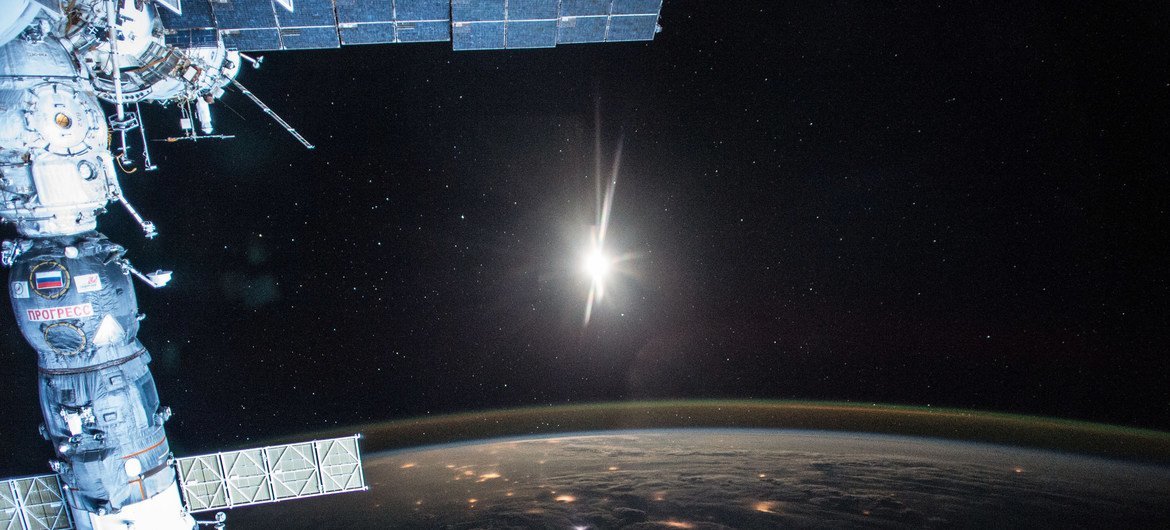
The breaking of dawn over planet Earth, seen from the International Space Station.
4 October 2018
SDGs
Highlighting the importance of space and its applications for humankind, the United Nations is celebrating World Space Week 2018 with a focus on the role the cosmos plays in bringing people together, back on earth.
“Space Unites the World,” the theme for World Space Week (WSW) 2018 is inspired by UNISPACE+50 – a UN conference in June this year – that brought together leaders in exploration, and experts on space applications from all over the globe.
In addition to promoting cooperation between space-faring and emerging space nations, UNISPACE+50 saw Member Sates pledge their collective efforts to enhance the ways space science is used for sustainable development.
► READ ALSO: If we can build the International Space Station, ‘we can do anything’ – UN Champion for Space
Marked annually from 4-10 October, World Space Week commemorates the launch of Sputnik I, the first artificial satellite to be put into orbit, by the Soviet Union, on 4 October 1957, as well as the entry into force just over a decade later, of what’s formally-known as the Treaty on Principles Governing the Activities of States in the Exploration and Use of Outer Space, including the Moon and Other Celestial Bodies.
Since 2007, over 94 nations have participated in more than 2,250 Space Week events, drawing more than 1.3 million attendees.
Major events this year include:
A Transatlantic Space Week at sea, onboard the Queen Mary 2 cruise ship, as it voyages from New York to Southampton.
The European Space Agency (ESA) hosts an Open Day on 7 October 7 at its technical centre in Noordwijk, Netherlands.
The Leicester National Space Centre in the UK hosts a Space Week Family Sleepover, giving enthusiasts the chance to snuggle up next to giant rockets – spacesuits are also available.
In the United States, women in the space industry in various cities, will take part in the ‘Ladies Do Launch’, event, consisting of a series of live audience interviews.
In Bangladesh, the non-profit Youthpreneur Network , hosts the Astronomy for Girls event, in the capital Dhaka.
Space boost for women and girls, in STEM fields
The Bangladesh event shows the emphasis being placed during Space Week on encouraging young women and girls to take up space science and the so-called STEM fields overall - science, technology, engineering and mathematics.
Speaking at UNISPACE+50, from the International Space Station – at a height of over 400 kilometres in low-Earth orbit – US astronaut Serena Auñón-Chancellor, offered some excellent advice for girls and young women wishing to pursue careers in the STEM fields but feel ambivalent asking questions or learning more people those already established.
“I tell them…bother people” she said. “Bother them if you are interested in their work and research, get them to tell you about it, ask questions … explore, discover and that is the best way for young girls and women to get interested in STEM fields.”
► READ MORE: From low-earth orbit, ‘envoys’ of humanity join UN space forum
Photo Gallery: Space for a better future, the journey of UNISPACE+50

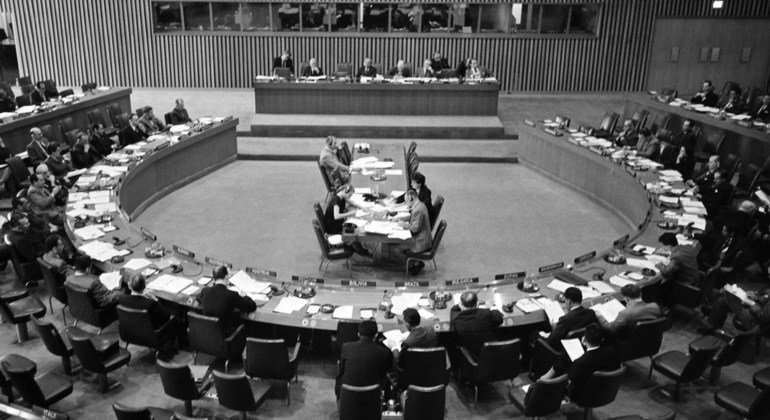
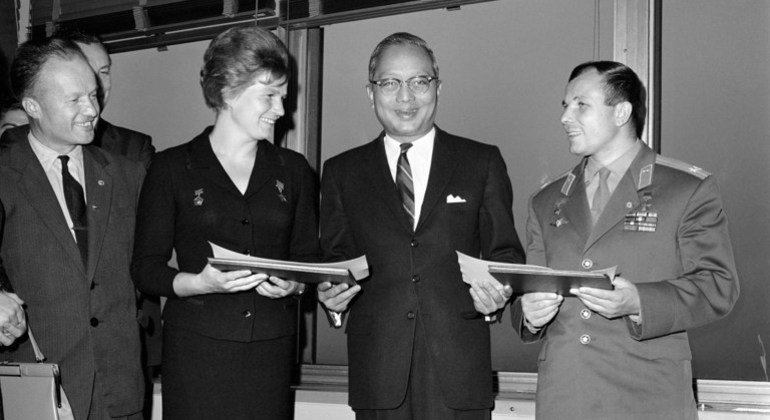


Left: Secretary-General U Thant (centre) with Soviet cosmonauts Yuri Gagarin (right) and Valentina Tereshkova (left), the first man and woman in space, respectively. Right: Scott Kelly, the UN Champion for Space, on board the International Space Station where he spent an entire year in space.
https://news.un.org/en/story/2018/10/1022292
Subscribe to:
Posts (Atom)
Sailing for Peace Coffee Talk

Climate Change Peace Building Adaptation Information Campaign Worldwide