FREE SYMPOSIUM OF AMB. JUAN

Extent of Coverage as of Today

Translate

Friday, July 19, 2019

SDGs: World ‘off track’ to meet most Sustainable Development Goals on hunger, food security and nutrition


Key parts of the Global Goals agenda linked to achieving zero-hunger are “off-track”, the UN Food and Agriculture Organization (FAO) said on Thursday, in an appeal for much greater public investment in farming.


Four years since the international community agreed to implement the 17 Sustainable Development Goals - whose objectives include tackling food insecurity and poor nutrition - FAO says that a lack of progress “is the norm”.

In a new report focusing on Goals 2 (Zero Hunger), 6 (Clean Water And Sanitation), 14 (Life Below Water) and 15 (Life On Land), the agency also warns of unsuccessful efforts to make farming sustainable, as well as the long-term management of land and ocean-based resources.


According to the study, Sub-Saharan Africa and Oceania - excluding Australia and New Zealand - registered the lowest levels of investment in the agricultural sector, which includes fisheries and forests.

Key findings from the study that covers some 230 countries include data that more than 820 million people are going hungry around the world.

That number has been rising for three years in a row “and is back to levels seen in 2010-2011”, FAO says.

The percentage of hungry people has also slightly increased between 2015 and 2018, to 10.8 per cent.
Six in 10 livestock breeds ‘at risk of extinction’

Among the report’s other findings is the warning that 60 percent of livestock breeds are at risk of extinction in the 70 countries for which information is available.

This means that out of more than 7,000 breeds that are found in only one country, almost 2,000 are threatened, FAO says.

Examples include Fogera cattle from Ethiopia or Bali’s Gembrong goat, according to FAO.

It notes too that there has been "no progress” in conserving the animal DNA that would be needed to create new herds in case of extinction, with less one per cent of their genetic blueprint currently stored, with ongoing efforts to preserve these resources proving to be “inadequate".
Plant conservation more successful

While there has been more success in conserving the genetic material of plants, with global stocks held in 99 countries and 17 regional and international centres totalling 5.3 million samples, FAO cautioned nonetheless that crop diversity is still too limited.

“Efforts to secure crop diversity continues to be insufficient,” the report states, “particularly for crop wild relatives, wild food plants and neglected and underutilized crop species.”
Investing in sustainable fisheries ‘is worth $32 billion annually’

Highlighting the need to invest in sustainable fishing, the report also warns that one-third of marine stocks are overfished today, compared with 10 per cent in 1974.

“Despite some recent improvements in fisheries management and stock status in developed countries, the proportion of stocks fished within biologically sustainable levels has decreased significantly in developing countries,” the UN agency says.

Around 30 per cent of countries still have a relatively low implementation record of key international instruments designed to combat illegal, unreported, and unregulated fishing, FAO maintains.

All countries should “urgently” implement transformational changes in fishery management and governance, FAO recommends, as rebuilding overfished stocks could increase annual fishery production by 16.5 million tonnes and annual revenues from fishing by $32 billion.
All continents face water stress, forest clearance ongoing

Among the report’s other findings are that water stress affects countries in every continent.

Nonetheless, the majority of countries that have registered high water stress since 2000, are mainly in Northern Africa, Western Asia and Central and Southern Asia.

In addition, between 2000 and 2015, the world lost an area of forest the size of Madagascar, owing mainly to agricultural use. Most of this loss was in the tropics of Latin America, Sub-Saharan Africa and South-East Asia.

On a more positive note, the rate of forest loss slowed down globally from 2010-2015, the FAO report notes, and this loss was partly compensated by the increase forest in Asia, North America and Europe.

https://news.un.org/en/story/2019/07/1042781
♦ Receive daily updates directly in your inbox - Subscribe here to a topic.

Thursday, July 18, 2019

1.4 million refugees set to need urgent resettlement in 2020: UNHCR. According to UNHCR’s Projected Global Resettlement Needs 2020 report, those with the greatest needs include nationals from Syria (40 per cent), South Sudan (14 per cent) and the Democratic Republic of the Congo (11 per cent)


“Given the record numbers of people needing safety from war, conflict and persecution and the lack of political solutions to these situations, we urgently need countries to come forward and resettle more refugees,” said UN High Commissioner for Refugees Filippo Grandi.


Globally, resettlement needs in 2020 are set to rise by one per cent compared with this year, driven by increased displacement in Africa and the Americas, which account for six and 22 per cent respectively.

At 450,000 people, the East and Horn of Africa region has the highest resettlement needs, reflecting ongoing insecurity in South Sudan despite a 2018 peace agreement, and protracted refugee situations in DRC, Central Africa, Eritrea, Somalia and Sudan, according to UNHCR.

This is followed by Turkey (420,000), which hosts 3.7 million refugees, the wider Middle East and North Africa region (250,000) and the Central Africa and the Great Lakes region (almost 165,000).
There has to be more equitable sharing of refugees: Grandi

“With the overwhelming majority, 84 per cent, of the world’s refugees hosted in developing regions facing their own development and economic challenges and whose own populations may live below the poverty line, there simply has to be a more equitable sharing of responsibility for global crises”, Mr. Grandi told Member States attending consultations in Geneva on resettlement for refugees.

Resettlement involves the relocation of refugees from a country of asylum to a country that has agreed to admit them and grant them permanent settlement.

It is regarded by UNHCR as a life-saving tool to ensure the protection of those most at risk or with specific needs that cannot be addressed in the country where they have sought protection.

In a bid to provide more vulnerable refugees with a new home in a third country – and amid significantly fewer resettlement opportunities globally in the last two years - UNHCR and partners on Friday unveiled an initiative in support of resettlement and other legal alternatives to enter countries, such as family, work and study routes.
Bid to resettle three million refugees globally by 2028

By the end of 2028, the objective of the strategy is to expand so-called “third country solutions” for three million refugees, with one million resettling in 50 countries and two million benefiting from alternative pathways.

A Global Refugee Forum is to be held in December in Geneva, which UNHCR believes is a “critical opportunity to galvanize support through commitments and pledges” from States and other relevant stakeholders.

“History has shown that with a strong sense of purpose, States can come together to collectively respond to refugee crises, and help millions to reach safety, find homes and build futures in new communities,” Mr. Grandi insisted.
UN rights experts urge more protection for LGBTI refugees

In a related development, UNHCR has added its support to a UN-appointed independent rights expert’s call for many more States to increase protection for the LGBTI community and to be more aware of their “unique vulnerability”.

Today, only 37 States grant asylum to individuals on the basis of persecution based on sexual orientation or gender identity, according to UNHCR’s Assistant High Commissioner for Protection, Volker Türk, and the UN Independent Expert Victor Madrigal-Borloz.

“For many LGBTI people, the trauma and persecution start well before their actual flight to safety,” Mr. Madrigal Borloz said. “Persecution often manifests through laws that criminalise sexual orientation, gender identity or expression or that are discriminatory.”

LGBTI people are also exposed to disproportionate levels of arbitrary detention, police abuse, violence and extrajudicial killings by both State and non-State actors, the Independent Expert said, “as well as abuse in medical settings, including forced sterilisations and so-called ‘conversion therapies’”.

Echoing that message, Mr. Turk added that many LGBTI refugees continue to face prejudice and violence in countries of transit and host countries.

Türk said that, even in locations where LGBTI refugees are more accepted and services are accessible, many choose to conceal their sexual orientation and gender identity for fear they might be targeted or marginalised, particularly in densely populated areas.

It is therefore crucial to create safe spaces and services that are designed in consultation with LGBTI people and their organisations.


1 July 2019
Migrants and Refugees


More than 1.4 million displaced people in over 60 refugee hosting countries will need resettlement next year, the UN refugee agency, UNHCR, said on Monday, while also supporting a call for far greater protection for vulnerable LGBTI individuals seeking asylum.


https://news.un.org/en/story/2019/07/1041632

Wednesday, July 3, 2019

Holland's Barriers to The Sea- Climate Change Update


The Delta Works in the Netherlands (Holland) is the largest flood protection project in the world. This project consists of a number of surge barriers, for examples:

1- The Oosterscheldekering is the largest of the 13 ambitious Delta Works series of dams and storm surge barriers and it is the largest surge barrier in the world, 9 kilometres (5.6 mi) long. The dam is based on 65 concrete pillars with 62 steel doors, each 42 metres wide. It is designed to protect the Netherlands from flooding from the North Sea.


2- The Maeslantkering is a storm barrier with two movable arms; when the arms are open the waterway remains an important shipping route however when the arms close a protective storm barrier is formed for the city of Rotterdam. Closing the arms of the barrier is a completely automated process done without human intervention.


Tuesday, June 11, 2019

WELLNESS IN ARTS: Murals help heal wounds of bloody conflict in Guatemala- UN Women

8 June 2019
Peace and Security


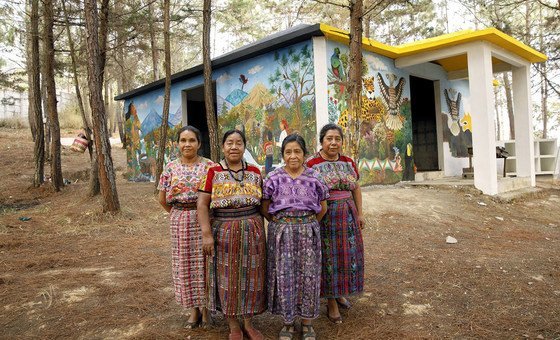
“The villagers knew that the military kidnapped [indigenous] people and brought them here and tortured them. While alive, they were forced to dig their own graves. Some would be buried in the ground, here, still half alive.” The chilling words of Rosalina Tuyuc Velásquez, a member of an indigenous group in Guatemala.

UN Women/Ryan Brown | Rosalina Tuyuc Velásquez (2nd left) helped to set up the Center for the Historical Memory of Women in San Juan Comalapa in Guatemala. (April 2018)

The horrific picture she paints was the reality experienced by many Guatemalans during the 36-year-long armed conflict between the military and guerilla groups which killed at least 200,000 people in the Central American country, beginning in the early 1960s.

Now, Rosalina and the women of San Juan Comalapa, a municipality some 80 kilometers from the capital, Guatemala City, have established a memorial for victims of the conflict, due in part to the support of UN Women, and other organizations.

The first of its kind in Guatemala, it is called the Center for the Historical Memory of Women, and has been painted with murals by artists from across the region.

Read more about the women of San Juan Comalapa and the memorial they have built to the dead and disappeared.

Thursday, May 16, 2019

UN chief lauds Fijians as ‘natural global leaders’ on climate, environment, hails ‘symbiotic relationship’ with land and sea


UN Photo/Mark Garten
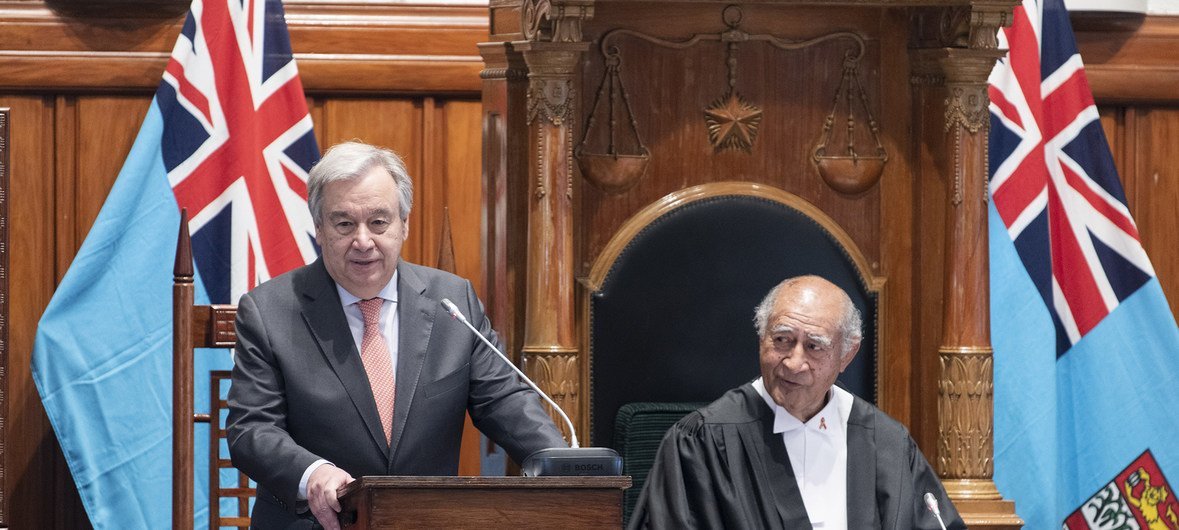
The UN Secretary-General António Guterres address the Fijian Parliament in the capital, Suva, on 16 May 2019.


16 May 2019
Climate Change


Fiji’s strong traditions of community and social responsibility, and its “symbiotic relationship” with its surroundings, has made its people “natural global leaders on climate and the environment”, United Nations Secretary-General António Guterrestold the nation’s Parliament on Thursday.


“Fiji has taken on the sceptics and the deniers” in a loud and clear voice, he said, “and the world is listening”.

The Secretary-General outlined that Fiji was the first small island State to preside over the UN Framework Convention on Climate Change (UNFCCC) and in 2017, became the first emerging market to issue a sovereign “green bond”, dedicated to environmental conservation. It introduced an Environment and Climate Adaptation Levy; launched a rural electrification programme to reduce diesel emissions; and has relocated villages and established guidelines on how to support people displaced due to climate change.


“Other countries in the region can learn from your example”, he congratulated.

Mr. Guterres pointed to the Fijian legislature as another of the country’s important achievements calling it “a place of inclusiveness, equality, diversity and tolerance”.

“We need that spirit more than ever at this time”, he said, noting rising anti-Semitism, anti-Muslim rhetoric, the persecution of Christians and other forms of xenophobia and racism.

The UN chief stressed the importance of showing solidarity in response to a “dangerous upsurge in hatred” and to combat the hate speech “coarsening our public dialogue in many countries and regions of the world”.

Citing the 2030 Agenda and the Sustainable Development Goals (SDGs) as “our blueprint for a fair globalization built on prosperous, peaceful and resilient societies on a healthy planet”, he commended Fiji for being the first parliament in the world to undertake an SDG self-assessment.
Climate change defines our time

Noting that climate change is “the defining issue of our time”, Mr. Guterres acknowledged how Fijians have suffered cyclones, floods and droughts, or lost their homes, schools or crops to rising seas, saying “the United Nations stands with you, I stand with you”.

He flagged the importance of financing, underscoring that given the amount of climate change that has already occurred, investment in adaptation “is especially crucial” in the Pacific region.

“We need developed countries to fulfill the pledges they have made
to support action in developing countries – including by mobilizing the public and private sector to reach $100 billion per year to support mitigation and adaptation”, the UN chief said, adding that the “successful replenishment of the Green Climate Fund” is also vital.


To help generate ambition, Mr. Guterres announced that he is convening a Climate Action Summit in September.

“My message to leaders is very clear: Don’t come with a speech; come with a plan”, he asserted. “I want leaders to showcase their plans to enhance Nationally Determined Contributions by 2020, and to cut emissions radically by 2025” by ending subsidies for fossil fuels and unsustainable agriculture and shifting towards renewable energy, electric vehicles and climate-smart practices.

Keys to sustainable growth, peace and prosperity:

Education and healthcare.
Decent jobs and economic opportunities.
Respect for human rights and the rule of law.
Gender equality, diversity and inclusion.
Fundamental freedoms and democratic values.


Carbon pricing must reflect the true cost of emissions, the UN chief said, “from climate risk to the health hazards of air pollution”. That means not constructing any coal plants beyond 2020 and replacing jobs in fossil fuel industries with “cleaner, healthier alternatives, so the transformation is inclusive, profitable and just”.

Noting “rampant” overfishing and plastic pollution that is “poisoning and depleting” the oceans, he emphasized that “the world must do more”.

“The coming years will be a vital period to save the planet and to achieve sustainable, inclusive human development,” he said. “The alarm bells keep ringing”.

“We must address this global emergency with ambition and urgency”, the Secretary-General concluded, adding “every country has a role to play”.

Sailing for Peace Coffee Talk

Sailing for Peace Coffee Talk
Climate Change Peace Building Adaptation Information Campaign Worldwide

Search This Blog

Blog Archive