FREE SYMPOSIUM OF AMB. JUAN

Extent of Coverage as of Today

Translate

Thursday, August 16, 2018

Beyond food and fuel: Healthy soils help grow our food, clean our water, store carbon, and reduce risks of droughts and floods


To beat hunger and combat climate change, world must ‘scale-up’ soil health – UN
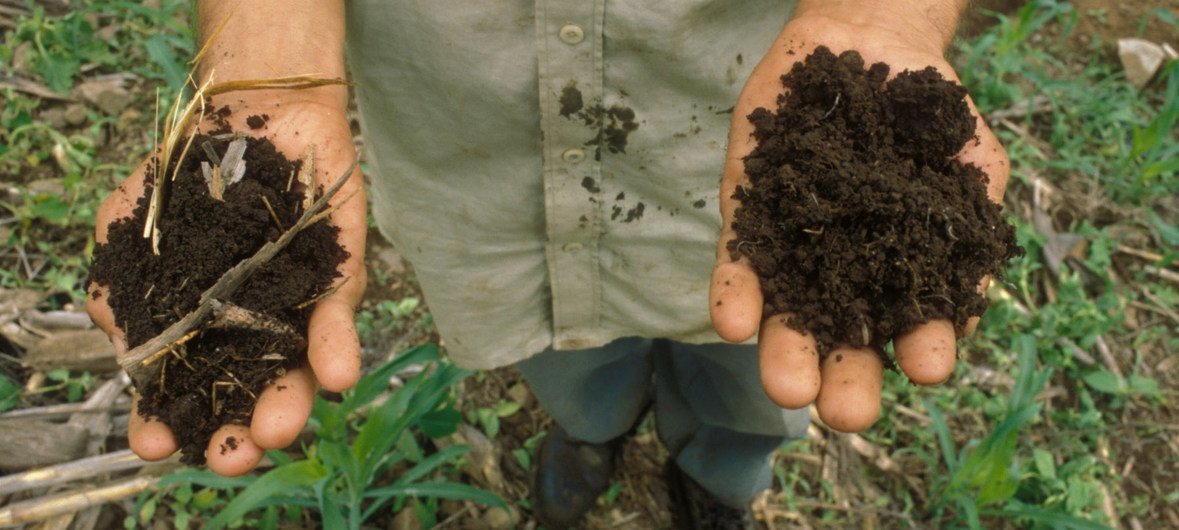


FAO/Giuseppe Bizzarri


Healthy soils are essential to achieve ‘Zero Hunger’ – and other Sustainable Development Goals (SDGs) – peace and prosperity, the United Nations agriculture agency chief underscored in Brazil at the World Congress of Soil Science.


On Sunday, more than 2,000 scientists gathered in Rio de Janeiro under the theme “Soil Science: Beyond food and fuel,” for a week of exploring the increasingly complex, diverse role of soils; grappling with resilient agriculture practices to address environmental and climatic changes; and confronting threats to food security and sovereignty.


“Soil degradation affects food production, causing hunger and malnutrition, amplifying food-price volatility, forcing land abandonment and involuntary migration-leading millions into poverty,” saidJosé Graziano da Silva, the Director-General of the Food and Agriculture Organizaation (FAO), in a video message noting that approximately one-third of the Earth’s soil is degraded


The FAO The Status of the World's Soil Resources report had identified 10 major threats to soil functions, including soil erosion, nutrient imbalance, acidification and contamination.


Mr. Graziano da Silva stressed the importance of sustainable soil management as an “essential part of the Zero Hunger equation” in a world where more than 815 million people are suffering from hunger and malnutrition.


Soils and climate change


“Although soils are hidden and frequently forgotten, we rely on them for our daily activities and for the future of the planet,” the FAO chief said, underscoring the important support role they play in mitigating or adapting to a changing climate.


Mr. Graziano da Silva specifically pointed to the potential of soils for carbon sequestration and storage – documented in FAO’s global soil organic carbon map.


“Maintaining and increasing soil carbon stock should become a priority,” asserted the UN agriculture chief.


He also noted how soils act as filters for contaminants, preventing their entry into the food chain and reaching water bodies such as rivers, lakes and oceans, flagging that this potential becomes limited when contamination exceeds the soils’ capacity to cope with pollution.


In his message, Mr. Graziano da Silva noted the Global Soil Partnership in which FAO works with governments and other partners to build technical capacity and exchange knowledge on sustainable soil management through the Voluntary Guidelines for Sustainable Soil Management.


“Let us make soils a vehicle of prosperity and peace, and show the contribution of soils to achieve the Sustainable Development Goals,” concluded the FAO Director-General said.


AGRICULTURE|CLIMATE CHANGE

UN agency is offering its expertise to farmers and Governments in the region to help them manage Fall Armyworm


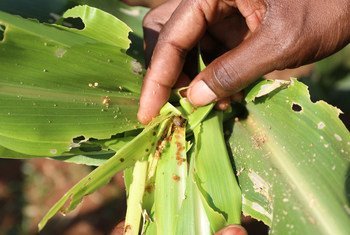
An “invasive pest” that devours more than 80 different plant species, including many staple crops, could threaten the food security and livelihoods of millions of small-scale farmers in Asia, the Food and Agriculture Organization (FAO) warned on Tuesday.
The UN agency is offering its expertise to farmers and Governments in the region to help them manage Fall Armyworm. The insect was recently detected in India, marking the first time it has been found in Asia, and FAO fears it is “highly likely” to spread, with southeast Asia and south China most at risk.
“Fall Armyworm could have a devastating impact on Asia's maize and rice producers - mostly small-scale farmers who depend on their crops for food and to make a living,” said Kundhavi Kadiresan, FAO Assistant Director-General and Regional Representative for Asia and the Pacific.
She described the arrival of the pest, which has been moving steadily east across the globe, as “a threat that we cannot ignore.”

FAO/Rachel Nandalenga
Small-scale farmers cultivate roughly 80 per cent of farmland in Asia, where more than 200 million hectares of maize and rice are cultivated each year, according to FAO. Meanwhile, over 90 per cent of the world’s rice is produced and consumed there.
The fear is that Fall Armyworm, which can fly 100 kilometres at night, could chomp through crops year-round, given the region’s “favourable” climate.
Though native to the Americas, Fall Armyworm has been on the march across Africa over the past two years, affecting millions of hectares of maize and sorghum.
It was first detected in Nigeria in January 2016.  Two years later, it had spread to practically all of sub-Saharan Africa, with the exception of 10 mostly northern countries and territories.
FAO took immediate steps to tackle Fall Armyworm in Africa and to support countries in mitigating the damage it caused. The agency has supported more than 30 projects on the continent to fight the pest, which can eat dozens of crop species, including maize, rice, vegetables, groundnuts and cotton.
Hans Dreyer, Director of FAO's Plant Production and Protection Division, believes action taken in Africa can also benefit Asia.
"Much of what FAO has already done in sub-Saharan Africa to help farmers and governments better monitor and mitigate Fall Armyworm damage, can also be applied in Asia,” he said.
“This includes recommendations on pesticide management, monitoring and early warning, and a practical guide for farmers and government extension workers on how to best manage the pest.”

Monday, August 13, 2018

PEACE LEADERSHIP on Climate Change: India and the UN: Celebrating 70 years of invaluab...

PEACE LEADERSHIP on Climate Change: India and the UN: Celebrating 70 years of invaluab...: From protecting civilians, disarming ex-combatants and helping countries transition from conflict to peace, Indian men and women in uniform...

PEACE LEADERSHIP on Climate Change: UN humanitarians scale up life-saving aid to over ...

PEACE LEADERSHIP on Climate Change: UN humanitarians scale up life-saving aid to over ...: To address the urgent needs of more than a million displaced by inter-communal violence in southwestern Ethiopia over the past four m...

UN launches guide for countries to improve location-based data management to better inform decision-making


The UN Statistics Division and the World Bank launched a new guide to help nations worldwide, especially in low- and middle-income countries, better manage data that contains geographical information – known officially as geospatial data.


The guide includes advice on how to collect, access and use geospatial information to develop effective policies, and more accurately support decision-makers in directing aid and development resources; ensuring that the most vulnerable are not left behind.


“Geospatial information is a critical component of national infrastructure and a blueprint of what happens where, and with proven societal and economic value,” said Stefan Schweinfest, Director of the Statistics Division, which is part of the UN Department of Economic and Social Affairs (DESA).


High-quality, timely geospatial information is often overlooked in policymaking - Anna Wellenstein (World Bank)


“Better understanding and management of digital location-based data and services, and good geospatial information integrated with urban planning and census data, can enable more efficient resource allocation for better service delivery,” he explained.


The guide, titled ‘Integrated Geospatial Information Framework’, makes concrete recommendations on establishing national geospatial information management processes and putting that information to use.


According to the UN Committee of Experts on Global Geospatial Information Management (UN-GGIM), with more reliable geospatial data, policy-makers, international organisations, civil society and others, will have better insights into the distribution of needs and ways to optimize development planning and investments.


“High-quality, timely geospatial information is often overlooked in policymaking, yet is fundamental to achieving inclusive growth and sustainable development,” said Anna Wellenstein, who leads land and geospatial activities at the World Bank.


Currently, all governments hold a considerable amount of geospatial information, including databases on who has access to education; communities most affected by poverty; areas at risk of disasters; as well as mobile data that can keep more people informed about disease outbreaks and weather patterns.


But the information, although critical to improve lives and livelihoods, is often not current, shared, or integrated with other necessary data.


“The Framework will help countries in building capacity for using geospatial technology to enhance informed government decision-making, facilitate private sector development, take practical actions to achieve a digital transformation, and bridge the geospatial-digital divide.”


The UN-GGIM stressed that this guide is also meant to help low- and middle-income countries move toward developing their “e-economies” to provide better social and economic services to citizens. For example, integrated geospatial information management can enable Small Island Developing States (SIDS) to better monitor climate change impacts, plan mitigation, and manage disaster risks.


Representatives from governments and geospatial information experts are attending the Eighth Session of the UN-GGIM in New York from 1 to 3 August to discuss efforts to enhance collaboration, coordination, and coherence in global geospatial information management. In November, high-level stakeholders will meet in Deqing, Zhejiang Province, China, at the UN World Geospatial Information Congress to ensure the widest and fullest use of geospatial information to advance social, economic, and environmental development.


UNDESA|UN COMMITTEE OF EXPERTS ON GLOBAL GEOSPATIAL INFORMATION MANAGEMENT


https://news.un.org/en/story/2018/08/1016162

Farmers living on the Indian Ocean Comoros archipelago are being supported through a UN Development Programme (UNDP) initiative, to adapt to climate change in an effort to ensure they can continue to prosper in one of Africa’s poorest nations

Some 200,000 Comorians rely solely on agriculture to make a living from crops such as ylang-ylang, vanilla and clove; fragrant plants which have led many to name the small island nation, the perfume islands.
But, changes to the climate are upending traditional agricultural practices and threatening the islanders’ livelihoods.
UNDP has partnered with the Government of Comoros to mentor farmers in a new agricultural approach.  https://news.un.org/en/story/2018/08/1016052
For more information  on this story please click here.

The world’s young people need safe spaces – both physical and digital - where they can “freely express their views” and “pursue their dreams” was the core message of United Nations Secretary-General António Guterres to mark this year’s International Youth Day.


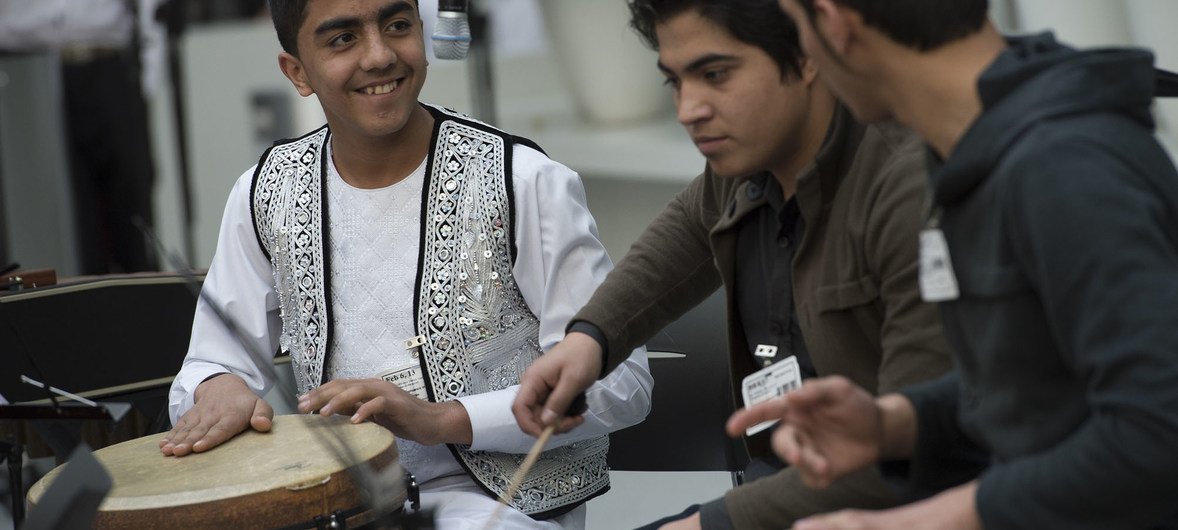
Students from the Afghanistan National Institute of Music, about half of whom are orphans and former street children and about one-third girls, play their instruments.


World Bank/Roxana Bravo


10 August 2018


Human Rights


“The hopes of the world rest on young people,” said the UN chief on Friday, in advance of the official Day, which is celebrated annually on 12 August.


“Peace, economic dynamism, social justice, tolerance – all this and more, today and tomorrow, depends on tapping into the power of youth,” he added.


There are currently 1.8 billion young people between the ages of 10 and 24 in the world – the largest youth population ever.


Political instability, labour market challenges and limited space for political and civic participation have led youth to becoming increasingly more isolated, raising the need for more safe spaces where they can meet, engage and express themselves.


We must invest so that young people have access to education, training and decent jobs to achieve their full potential –­ Secretary-General Guterres


Mr. Guterres pointed out that more than 400 million young women and men live amidst armed conflict or are vulnerable to organized criminal violence.


Moreover, he elaborated that “millions face deprivation, harassment, bullying and other infringements of their rights.”


Safe spaces offer security and dignity while interacting. These include civic spaces to engage in governance issues; public spaces to take part in community activity such as sport digital spaces to interact virtually across borders; and well-planned physical spaces for diverse youth; especially those vulnerable to marginalization or violence.


The 2030 Agenda for Sustainable Development, specifically Goal 11, emphasizes the need for the provision of space towards inclusive and sustainable urbanization.


“We must invest so that young people have access to education, training and decent jobs to achieve their full potential,” underscored the Secretary-General.


“The United Nations is strongly committed to listening to the voices of young people – and opening pathways for meaningful participation in decisions that affect them,” he continued, announcing a new strategy to be launched in September “to step up our work with and for young people.”


“In making the world safe for young people, we make the world better for all,” concluded Mr. Guterres, “I wish all a happy International Youth Day!”


For her message for the day, Jayathma Wickramanayake, the UN Youth Envoy, stressed: “Young women and girls are particularly vulnerable, as are young refugees and migrants, youth living in conflict-prone or humanitarian settings, and LGBTQI young people,” referring to lesbian, gay, bisexual, transgender and intersex.


Events to celebrate International Youth Day 2018 will take place all over the world to promote youth engagement and empowerment.


https://news.un.org/en/story/2018/08/1016832

Sailing for Peace Coffee Talk

Sailing for Peace Coffee Talk
Climate Change Peace Building Adaptation Information Campaign Worldwide

Search This Blog

Blog Archive